
For decades, engineers and curious minds have asked: are high tension power lines AC or DC? The short answer is most are AC, but the real story is more nuanced. Today, a growing number of long-distance and submarine links use HVDC (High Voltage Direct Current). Understanding why requires looking at history, economics, and physics – not just textbook definitions.
In power engineering, “high tension” (HT) refers to voltages above 1 kV. Typical transmission voltages range from 11 kV to 400 kV (and even 800 kV or 1,100 kV for UHV). The primary goal of HT lines is to move bulk power over long distances with minimal resistive loss (I²R). Higher voltage allows lower current for the same power, hence less heat loss.
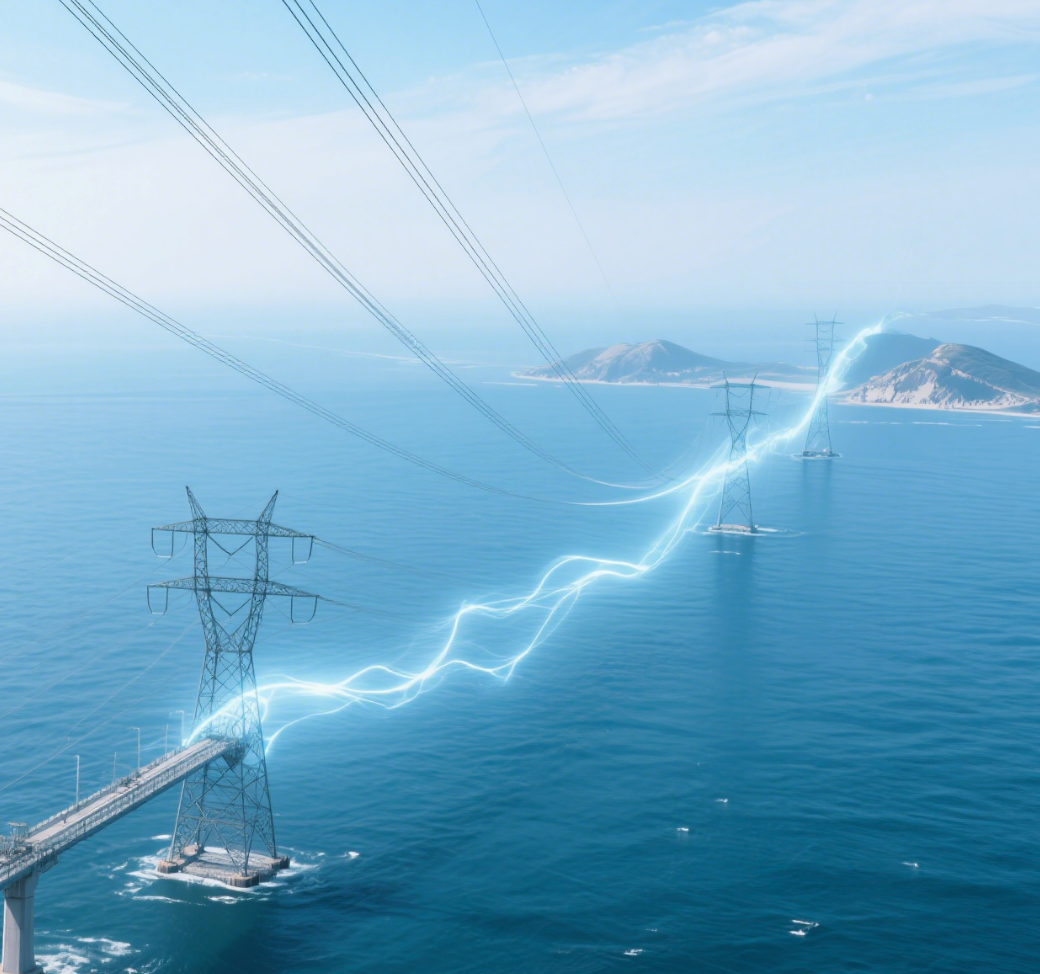
| Property | AC (Alternating Current) | DC (Direct Current) |
|---|---|---|
| Direction | Reverses periodically (50/60 Hz) | Constant flow |
| Voltage transformation | Simple and efficient using transformers | Requires expensive converter stations |
| Reactive power | Yes – causes additional losses and requires compensation | None |
| Skin effect | Significant at high frequencies | None |
| Synchronization | Must match grid frequency | Asynchronous connection possible |
The main reason AC became the standard is transformer efficiency. In the late 19th century, the “War of the Currents” ended with AC winning because DC could not be easily stepped up to high voltages. Even today, for distances up to about 600 km, AC is more economical:
Lower capital cost – No converter stations needed.
Simple voltage regulation – Tap-changing transformers allow dynamic control.
Grid interconnection – AC lines can directly connect to existing substations without conversion losses.
However, AC has inherent drawbacks: reactive power demand (which reduces usable capacity) and skin effect (current flows near the conductor surface, increasing effective resistance). These become significant beyond 600 km or in submarine cables.
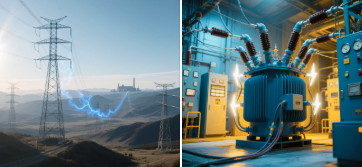
HVDC is not for routine transmission; it solves specific engineering challenges:
Very long overhead lines (>600 km) – Example: China’s ±800 kV UHVDC line from Xinjiang to Anhui (over 3,000 km) transmits 8 GW of renewable energy. The DC option reduces losses by roughly 30% compared to AC over that distance.
Submarine power cables – AC cables suffer from high capacitive charging current; beyond ~50 km, the entire cable capacity is consumed by charging current, leaving no room for active power. HVDC eliminates this problem. Example: North Sea Link (UK-Norway, 720 km, 1.4 GW) uses HVDC.
Asynchronous grid interconnections – Connecting grids with different frequencies (e.g., 50 Hz vs 60 Hz) or phases is impossible with AC. HVDC provides a “firewall” that decouples the systems. Example: Japan’s 50 Hz East / 60 Hz West grid is linked via HVDC back-to-back stations.
Underground long-distance cables – Urban areas often require underground cables; AC underground cables have high reactive losses, while DC does not.
For a 1,000 km overhead line at 500 kV, AC losses are approximately 6-8% of transmitted power, while HVDC losses are 3-4%.
Converter stations at each end add about 0.6% loss per station (total ~1.2% for a point-to-point link).
Break-even distance: above 600-800 km, HVDC becomes cheaper overall due to lower line losses and narrower right-of-way (DC needs only 2 conductors instead of 3 for AC).
| Feature | AC Transmission | DC Transmission (HVDC) |
|---|---|---|
| Conductors per tower | Typically 3 (one per phase) | 2 (positive and negative pole) |
| Tower design | Wider cross-arms for phase clearance | Narrower, sometimes lighter |
| Insulation | Must handle peak voltage and switching surges | Lower insulation requirements for same power |
| Substation equipment | Transformers, circuit breakers, reactors | Converter valves, smoothing reactors, DC filters |
| Maintenance | Frequent insulator cleaning, line patrols | Additional converter station maintenance |
Despite DC’s efficiency advantage over long distances, AC remains dominant because:
Short to medium distances (<500 km) – AC is cheaper to build and maintain.
Existing infrastructure – The entire grid is AC-based; converting to DC would require massive replacement.
Interrupting DC current is harder – DC circuit breakers are more complex and expensive than AC breakers.
If you are selecting or designing a transmission system:
Use AC for lines under 500 km, feeding into local grids, and where multiple tapping points are needed.
Use HVDC for submarine links, very long overhead lines (>600 km), connecting asynchronous grids, or when right-of-way is extremely expensive (DC towers are narrower).
This article was reviewed by Chen Wei, senior power systems engineer with 15+ years experience in HVDC projects (including the Zhangbei multi-terminal DC grid). The technical data is sourced from CIGRÉ (International Council on Large Electric Systems) and IEEE standards. For specific project requirements, always conduct a full feasibility study.
We specialize in high-quality electrical components for both AC and DC applications – from solar DC circuit breakers to industrial AC contactors. Our engineers support custom solutions for transmission auxiliary systems. Visit our product page or contact our technical team for consultation.
Q: Are the high tension lines I see on highways AC or DC?
A: Almost certainly AC. Overhead lines visible from roads are AC (usually 110 kV to 400 kV). HVDC lines are rarer and often marked with “HVDC” on towers.
Q: Can HVDC be used for rooftop solar integration?
A: No – residential solar panels produce low-voltage DC, which is converted to AC by the inverter. HVDC is only for utility-scale long-distance transmission.
Q: Is DC transmission safer than AC at high voltages?
A: Both are lethal. DC arc faults are harder to extinguish because current has no zero crossing. Safety clearances and insulation are comparable.
Q: How do converter stations affect reliability?
A: Modern HVDC systems have availability above 99.5%. Redundant valve groups and bypass switches minimize downtime.
 English

