
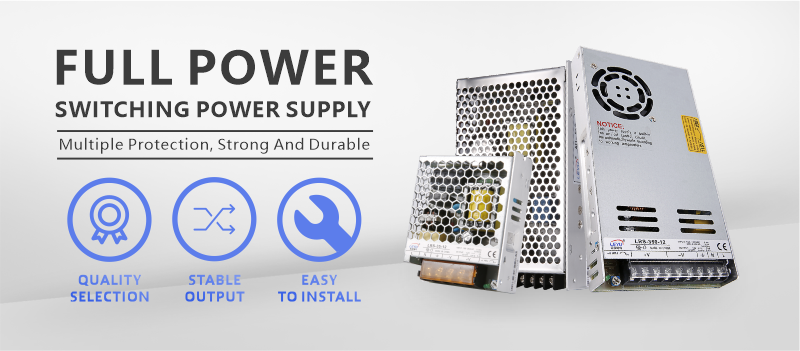
This guide helps you diagnose common switching power supply failures. While high‑quality power supplies like the Leyu SD series are designed withcomprehensive protections (short circuit, overload, overvoltage, over‑temperature) and 100% full‑load burn‑in testing, no electronic device is immune to field failures.
When problems occur, follow this structured approach.
Use a multimeter to confirm that the input voltage matches the power supply’s rated AC (e.g., 100–240VAC) or DC range (for DC‑DC converters like
Leyu SD series: 9.2–18V, 19–36V, 36–72V, or 72–144VDC).
If input voltage is absent, inspect upstream components such as distribution boards, circuit breakers, or uninterruptible power supplies (UPS).
- Look for blown fuses – a broken filament or darkened glass indicates an overcurrent event.
- Ensure all terminal blocks and connectors are tight. Loose connections cause intermittent failures and arcing.
- For Leyu SD series, the input side may include a fuse (especially on SD‑500 models with reverse polarity protection). Replace only with the same rating.
⚠️ Safety First: Always disconnect power and safely discharge high‑voltage capacitors (using a resistor, e.g., 10kΩ/5W) before touching internal components.
- After discharge, check the DC bus voltage. An abnormally low reading points to a faulty rectifier bridge or primary smoothing capacitors.
- For Leyu SD series (fixed switching frequency at 83KHz for most models, 37KHz for SD‑15), locate the PWM controller IC. Measure its VCC supply voltage
and compare against the datasheet.
- No VCC indicates a failed startup resistor or auxiliary winding.
- Oscilloscope can verify if the PWM is generating gate drive signals.
- Use an electronic load or a high‑power resistor bank that matches the power supply’s rated current (e.g., for SD‑150B‑12: 12.5A at 12V).
- If the output voltage sags excessively under load, suspect:
- Aging output electrolytic capacitors (bulging or leaking)
- Poor feedback regulation (unstable optocoupler or TL431)
- Actual load exceeding the supply’s maximum current rating
Leyu SD series features overload protection (105‑150% of rated power, hiccup mode or shutdown). A sustained overload may trigger protection.
Remove the overload and repower to recover.
- Unstable output (ripple, oscillation, or voltage jumping) often comes from:
- Faulty optocoupler (leakage or slow response)
- Bad reference (TL431) or compensation network
- Output capacitor with high ESR
- Also verify that the connected load does not have large dynamic swings that the supply cannot follow.
- Power Down & Discharge: Always disconnect from mains and discharge high‑voltage capacitors before probing.
- Use Isolation Transformer (for AC‑DC)**: When taking live measurements on AC‑DC supplies, an isolation transformer reduces shock risk.
- Personal Protective Equipment (PPE)**: Wear safety glasses and use insulated tools. Capacitors can explode if shorted incorrectly.
Proactive Maintenance Tips
Regular maintenance prevents many power issues – especially important for industrial or vehicle‑mounted Leyu SD series converters.
| Maintenance Task | Benefit |
| Thermal inspection – Use infrared camera to spot hot components (transformers, MOSFETs, input rectifier) | Early detection of overload or heatsink issues |
| Capacitor check – Visually inspect electrolytic capacitors for bulging, vent rupture, or leakage | Electrolytic caps are the #1 failure point |
| Environmental control – Keep within rated temperature and humidity. Clean dust from fan‑cooled models (SD‑250/350/500) | Extends lifespan significantly |
Power supply troubleshooting is a logical process: “outside → inside, input → output, simple → complex.” Most common faults – blown fuse, dead PWM, bad capacitors, or failed optocoupler –
can be located with a multimeter and basic tools.
When repair is not practical (e.g., potting, lack of schematics, or safety concerns), replacing the entire power module is safer and more reliable. Leyu SD series offers a wide range of
15W to 500W DC‑DC converters with 2‑year warranty and 100% burn‑in, making replacement a cost‑effective choice.
 English

