
As a professional switching power supply account manager with years of B2B industry service experience, I have served hundreds of factories, data centers, medical institutions, telecommunication operators, and financial enterprises. From actual project cases, unexpected power outages, voltage surges, and grid fluctuations are the top hidden risks causing B-end enterprise shutdown losses, equipment burnout, and core data corruption.
Many corporate procurement and engineering teams overlook the importance of matching high-quality UPS charging power supply, resulting in tens of thousands of dollars in invisible losses from short-term power anomalies. A qualified UPS charging power supply is not a redundant power device, but a core guarantee for enterprise continuous production, business continuity, and equipment safety. This authoritative B2B guide sorts out UPS types, core parameters, selection standards, application scenarios, maintenance schemes and industry innovation trends, helping global business buyers quickly complete high-cost-performance UPS procurement and avoid project risks.
UPS (Uninterruptible Power Supply) charging power supply is a professional industrial and commercial grade power protection device integrating charging, power storage, power conversion and emergency power supply. Different from ordinary civilian power supplies, B-end dedicated UPS charging power supply features zero-switching delay, wide voltage adaptation, long cycle life, and strong anti-interference, fully adapting to complex industrial and commercial power environments.
Its core three-in-one component system ensures stable power operation:
Charger: Intelligent constant current and constant voltage charging, automatically managing battery charging status under normal grid power, preventing overcharging and undercharging, and extending battery service life.
Battery Pack: Industrial-grade energy storage unit, storing electric energy for emergency use; supporting long-term standby and frequent switching to adapt to fluctuating grid environments.
Inverter: High-efficiency power conversion module, converting DC stored power into standard AC power that meets equipment operation standards, with a conversion efficiency of up to 96% for mainstream industrial models.
When the municipal power supply is normal, the UPS charging power supply completes battery charging and standby protection; when power outage, surge, voltage drop or grid distortion occurs, it automatically switches to battery power supply within 10ms ultra-fast response, ensuring zero downtime of critical equipment.
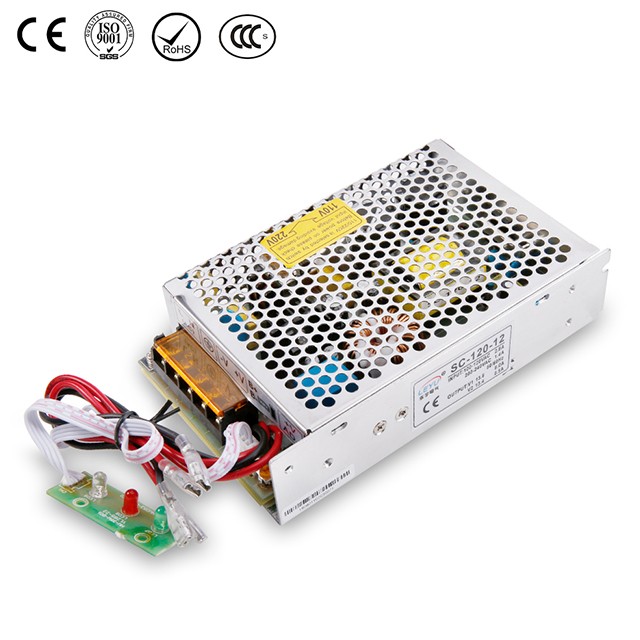
For enterprise procurement, selecting a UPS by scenario is the core of cost control. We summarize the applicable scenarios, advantages and limitations of four mainstream UPS types for B-end buyers’ quick reference:
Standby (Offline) UPS: Entry-level cost-effective model, with basic surge protection and emergency power supply functions. Suitable for small office equipment, single computer terminals, and low-power monitoring devices; ideal for small and micro enterprises with low power protection requirements.
Line-Interactive UPS: Mid-range mainstream model, with automatic voltage regulation function. It does not consume battery power for minor grid voltage fluctuations, featuring energy saving and low loss. Widely used in supermarkets, small and medium-sized communication base stations, and ordinary industrial control equipment.
Online (Double-Conversion) UPS: High-end industrial and commercial dedicated model. It realizes full-time AC-DC-AC double conversion, outputting pure sine wave stable power, completely isolating grid interference. The first choice for data centers, medical equipment, precision instrumentation, and financial transaction systems with ultra-high power stability requirements.
Multi-Mode UPS: New intelligent integrated model, combining the advantages of the above three types. It automatically switches the working mode according to real-time grid quality, balancing high protection performance and energy-saving efficiency, and is the preferred solution for large industrial parks and comprehensive commercial buildings.
Many B-end purchasers only focus on price and ignore core parameters, leading to frequent equipment failures after procurement. Based on years of project experience, the four core indicators that determine UPS practical value are sorted out:
Rational Power Capacity: Match the total power of load equipment with 1.2-1.5 times redundancy, avoiding full-load operation which causes attenuation of UPS service life. Industrial production lines and data center equipment need high-power customized models.
Battery Durability & Cycle Life: VRLA batteries are suitable for low-budget conventional scenarios; lithium-ion batteries have 3-5 times longer service life, lower maintenance cost, and faster charging speed, which is the mainstream choice for long-term enterprise cost reduction.
Ultra-Fast Seamless Switching: Professional B-end UPS achieves switching within 10ms, ensuring no restart or data loss of precision equipment, which is an essential indicator for medical and financial scenarios.
Comprehensive Surge & Voltage Protection: Effectively filter grid spikes, high and low voltage fluctuations, and harmonic interference, protecting high-value industrial equipment and precision instruments from burnout damage.
The core value of UPS charging power supply for enterprises is avoiding shutdown losses, protecting asset safety, and ensuring business continuity. The mature landing scenarios are as follows:
Data Center & IT Infrastructure: Prevent server downtime and data loss, ensure 7×24h uninterrupted operation of cloud storage and network systems, and reduce enterprise data security risks.
Telecommunication Industry: Support long-term stable operation of mobile base stations and transmission equipment, avoid regional communication service interruptions caused by power failures, and guarantee user service continuity.
Medical & Healthcare Institutions: Provide continuous power supply for ventilators, dialysis machines, and patient monitoring equipment, ensuring the safety of critical patients and normal operation of medical diagnosis and treatment work.
Industrial Manufacturing: Protect automated production lines, PLC control systems, and precision processing equipment, avoid production line shutdown and product scrapping caused by power anomalies, and reduce industrial production losses.
Financial Institutions: Guarantee stable operation of trading systems and settlement equipment, prevent transaction failure and data errors, and ensure the security and efficiency of financial business.
Renewable Energy & Off-Grid Systems: Adapt to solar energy, wind energy and off-grid microgrid scenarios, stabilize new energy power output, solve the problem of unstable voltage of renewable energy, and ensure continuous power supply of remote equipment.
Regular professional maintenance can extend the UPS system service life by 30%+ and reduce enterprise equipment replacement costs. Combined with after-sales service experience, the key maintenance and common fault solutions are summarized:
Regular battery health testing, terminal cleaning and corrosion prevention; quarterly system functional power-off simulation test; timely firmware upgrade to optimize operating efficiency; real-time monitoring of voltage and load operation status.
Battery non-charging/voltage attenuation: Timely replace aging batteries and optimize ambient temperature (20-25℃ is the best operating temperature); Inverter overheating and abnormal noise: Check load overload and heat dissipation failure, repair or replace accessories in time; Frequent power surge interference: Match professional surge protection modules to optimize grid connection environment.
Green Energy-Saving Upgrade: New generation UPS systems adopt high-efficiency energy-saving modules, with Energy Star certification, low energy consumption and low carbon emission, helping enterprises reduce operating energy consumption costs.
Popularization of Lithium-Ion Batteries: Lithium UPS batteries have become the mainstream, with ultra-long service life, maintenance-free and fast charging characteristics, greatly reducing enterprise later-stage operation and maintenance costs.
Smart IoT Remote Monitoring: Cloud-connected smart UPS realizes real-time remote data monitoring, fault alarm and parameter adjustment, reducing manual inspection costs and improving system operation stability.
For B-end industrial and commercial enterprises, UPS charging power supply is an indispensable core power protection device. Reasonable selection, standardized use and scientific maintenance can effectively avoid economic losses and safety risks caused by power anomalies. As a professional switching power supply supplier serving global B-end customers, we provide customized UPS solution design, parameter matching, after-sales technical support and one-stop procurement services for different industry scenarios, helping enterprises build stable and reliable power protection systems.
Q1: What are the core components of a standard UPS charging power supply?
A: It consists of three core modules: charger, battery pack and inverter, supplemented by static bypass switch and ATS automatic transfer switch, realizing automatic switching, stable power supply and safe protection functions.
Q2: How to choose the right UPS model for industrial production?
A: Determine the power capacity according to the total load of production equipment, select online double-conversion UPS for high-precision equipment, and prioritize lithium battery models for long-term operation scenarios to reduce maintenance costs.
Q3: What are the advantages of lithium-ion UPS compared with traditional lead-acid models?
A: Longer service life, faster charging speed, lower maintenance frequency, smaller volume and higher energy efficiency, more suitable for long-term continuous operation of B-end enterprises.
Q4: How often does a UPS system need professional maintenance?
A: It is recommended to conduct a full inspection every quarter and a comprehensive professional maintenance every year to eliminate potential faults and extend system service life.
 English

