Views: 0 Author: Site Editor Publish Time: 2026-10-22 Origin: Site
Micro-outages, voltage sags, and transient surges cause catastrophic data loss and hardware degradation in critical infrastructure. Operational disruptions stem directly from power anomalies that last only milliseconds. A momentary dip in voltage forces sensitive servers to reboot abruptly, corrupting active databases and requiring hours of intensive recovery protocols. Standard power supplies are designed strictly for basic power conversion. They change alternating current (AC) from the grid into direct current (DC) for internal components. They lack the internal mechanisms to bridge supply gaps or condition dirty grid power. This leaves high-availability systems completely vulnerable to immediate failure during grid instability. Relying solely on basic conversion hardware guarantees eventual downtime when the utility feed fluctuates. You must implement a robust architectural upgrade to protect mission-critical deployments. Integrating a UPS Charging Power Supply solves this core operational problem. It serves as a necessary shield, providing continuous power and active filtration.
Architectural Difference: Standard power supplies convert grid power directly to the load; a UPS charging power supply integrates continuous battery charging and isolation circuitry to provide instantaneous, uninterrupted, and clean power during outages.
Power Conditioning: Beyond backup power, true UPS systems actively filter electrical noise and regulate voltage, protecting sensitive components from long-term degradation caused by power fluctuations.
Sizing Complexity: Evaluating a UPS requires calculating true wattage using the power factor (typically 0.6 to 0.9). Buyers must divide their equipment's total wattage by the power factor to determine the correct Volt-Amp (VA) rating for procurement.
Deployment Context: Standard power supplies are sufficient for non-critical edge devices, whereas a UPS charging power supply is mandatory for servers, medical equipment, and industrial control systems requiring zero transfer time.
Table of Contents
Standard power supplies perform a singular, highly specific function within electronic devices. They convert alternating current from the mains into stable direct current. Internal components, such as motherboards, processors, and storage drives, require stable direct current to operate. The standard operational flow involves passing incoming grid power through a series of rectifiers and transformers. The conversion process follows a strict sequence:
Alternating current enters the unit and passes through a basic electromagnetic interference (EMI) filter.
A bridge rectifier flips the negative cycles of the sine wave, creating a pulsating direct current.
Internal capacitors smooth this pulsation into a steady voltage line.
Switching transistors regulate the output to specific voltages required by the hardware, such as 12V, 5V, and 3.3V.
This basic conversion process lacks meaningful energy storage capabilities. Capacitors in standard units only hold a microscopic electrical charge. They provide mere milliseconds of hold-up time. Hold-up time is the exact duration the supply maintains output after losing input power. A typical high-quality power supply offers roughly 16 milliseconds of hold-up time. This is vastly insufficient for bridging actual power gaps. When the grid drops, the capacitors drain almost instantly, causing the connected equipment to shut down abruptly.
Grid power rarely remains perfectly clean or perfectly stable. Standard power supplies face severe vulnerabilities when subjected to common grid anomalies. They cannot handle brownouts effectively. A brownout is a sustained period of low voltage where the grid fails to deliver the expected 120V or 240V. During a brownout, the standard power supply struggles to draw enough current to maintain its required output wattage. It overheats rapidly, stressing internal components. Standard units also fail to block high-voltage spikes. Lightning strikes or grid switching events cause massive voltage surges that punch through basic surge protection mechanisms. Harmonic distortion presents another significant threat. Heavy industrial equipment on the same grid introduces severe electrical noise that distorts the standard sine wave.
Grid Anomaly | Description | Impact on Standard Power Supply |
|---|---|---|
Brownout (Sag) | Sustained low voltage from the utility grid. | Forces the unit to draw higher current, causing rapid overheating and component stress. |
Voltage Spike | Sudden, massive increase in voltage (e.g., lightning). | Punches through basic varistors, destroying internal rectifiers and connected motherboards. |
Micro-Outage | Complete power loss lasting less than one second. | Exceeds the 16ms hold-up time, resulting in an immediate hard crash of the system. |
Harmonic Distortion | Electrical noise altering the pure sine wave. | Degrades silicon pathways over time due to inconsistent power delivery. |
Hardware consequences manifest quickly under these harsh conditions. Capacitors age prematurely due to constant thermal stress. Ungraceful shutdowns cause severe data corruption as read and write heads crash into physical disk platters. Thermal stress degrades the microscopic silicon pathways on internal processors, leading to premature failure.
A UPS charging power supply provides regulated DC power and maintains battery charging during normal operation. When the main supply fails, a compatible backup circuit allows the battery to support connected equipment. Charging control and electrical protection help maintain reliable operation and prevent unintended current flow. Explore our UPS Battery Charger Power Supply solutions for industrial DC backup applications.
UPS transfer time depends on the power supply design. Offline UPS systems generally require a brief switching interval, while line-interactive models provide voltage regulation and battery backup. Online double-conversion UPS systems continuously supply power through an inverter, avoiding transfer interruption during normal mains failure. Industrial DC UPS charging supplies use different backup circuits, so their actual switching performance should be verified against product specifications.
UPS output waveform quality affects compatibility with AC-powered equipment. Pure sine wave UPS systems provide a regulated AC waveform suitable for many sensitive electronic loads, while simulated sine wave models may have limitations with certain power supplies. However, industrial DC UPS charging power supplies provide DC output and do not inherently generate an AC sine wave. Buyers should select the appropriate output type according to their equipment requirements.
Selecting a UPS backup power supply requires evaluating the connected equipment, required backup duration, electrical conditions, and monitoring capabilities.
UPS battery backup can maintain power to connected equipment while a standby generator starts and reaches stable operation. For AC UPS systems, generator compatibility depends on acceptable input voltage and frequency ranges. Industrial DC backup supplies can also maintain compatible DC loads during temporary interruptions, provided the battery capacity and system configuration meet the required runtime.
UPS monitoring software can help protect servers and other electronic equipment during extended outages. Compatible systems may provide battery status alerts, remote monitoring, and automated shutdown functions before stored energy is exhausted. These features depend on the UPS communication interfaces and software support and should be confirmed before purchasing.
UPS power conditioning helps protect electrical equipment from selected voltage fluctuations and power disturbances. Depending on the topology, UPS systems may provide voltage regulation, filtering, or regulated output power. For industrial DC equipment, a suitable regulated backup power supply helps maintain stable operating voltage and reduces interruptions caused by mains failures.
Correct UPS sizing requires considering electrical load, backup runtime, startup demands, and future expansion requirements.
UPS capacity is commonly expressed in watts (W) and volt-amperes (VA) for AC systems. Watts represent real power, while VA represents apparent power. Both ratings must accommodate the connected equipment. For industrial DC UPS power supplies, buyers should instead verify output voltage, rated current, total output power, and the charging capacity available for the battery.
Startup current and peak power demand may exceed equipment's normal operating consumption. Motors, industrial controllers, and other electrical devices can require additional power during startup or load changes. A UPS should have suitable overload capability and sufficient capacity for these conditions. The required margin depends on actual equipment specifications rather than a universal percentage.
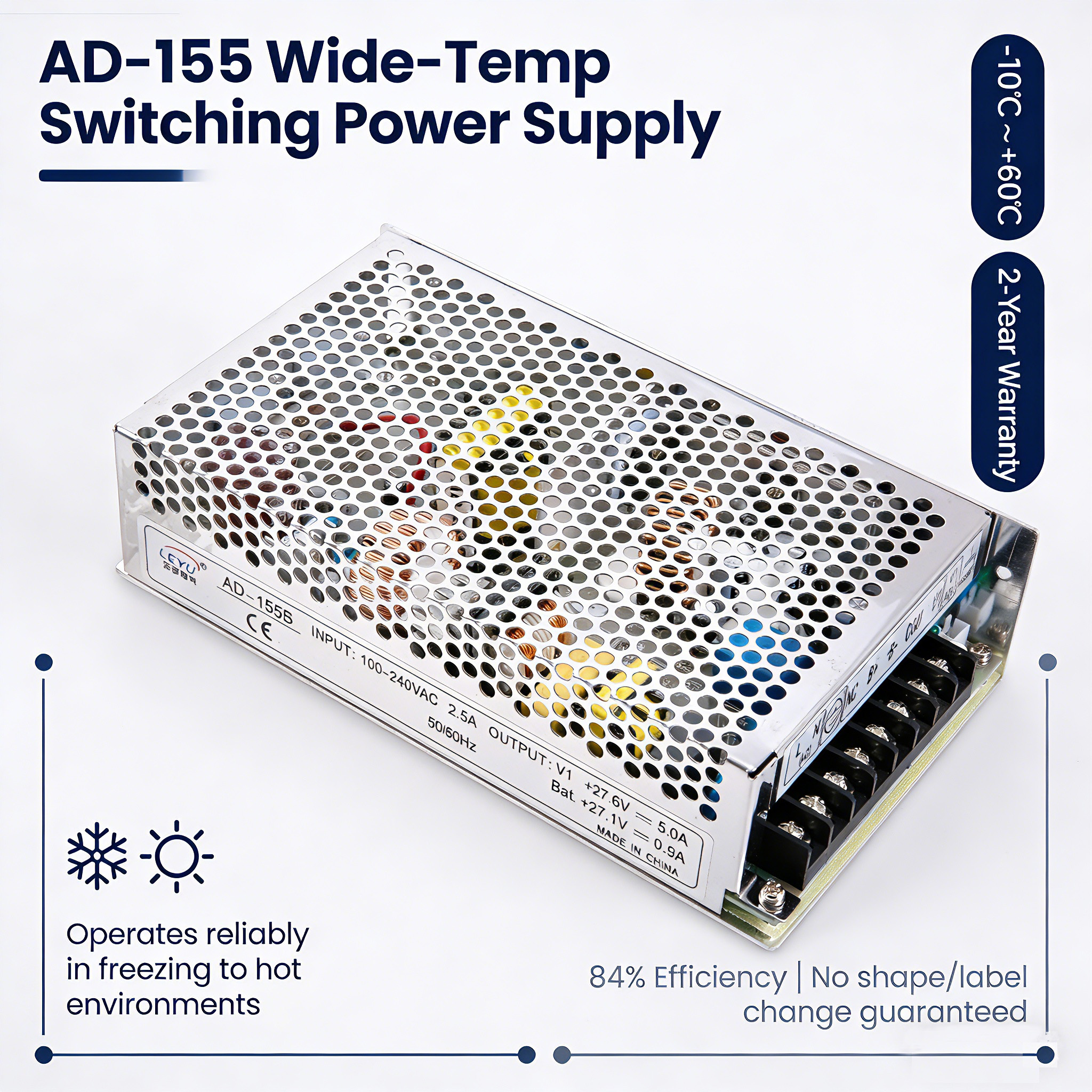
UPS backup runtime can be extended in compatible systems by increasing battery capacity. However, battery expansion must match the charging circuit, supported battery type, and equipment specifications. For industrial DC applications, our AD-155 UPS Charging Power Supply provides battery charging and backup functionality for supported external battery configurations.
Conduct a comprehensive power audit of your facility to identify all critical loads requiring zero-transfer-time protection.
Calculate your aggregate true wattage requirements using the power factor formula to establish an accurate baseline for procurement.
Assess your facility's thermal capacity and structural floor support to ensure the environment can handle the heat and weight of the new hardware.
Select the appropriate UPS topology based on your equipment's sensitivity, prioritizing online double-conversion for enterprise data centers.
Implement network management cards and configure automated shutdown scripts to guarantee data integrity during extended grid failures.
A: It provides instantaneous battery backup and clean power conditioning to connected equipment during grid failures, preventing data loss and hardware damage.
A: Generally, no. Standard power supplies only have milliseconds of hold-up time in their capacitors, meaning even a sub-second power dip can cause a system reboot or crash.
A: Divide the total wattage of your connected devices by the UPS's power factor (usually between 0.6 and 0.9) to determine the required VA rating, then add a 20-30% buffer for inrush current.
A: Pure sine wave perfectly replicates clean utility power and is required for sensitive electronics; simulated sine wave produces a blocky, stair-step waveform that can cause issues or failure in devices with Active PFC power supplies.
A: Because of the power factor, which accounts for the inefficiency in how alternating current is utilized by the connected equipment. The wattage rating represents the actual power available to do work.
A: Standard VRLA batteries typically require replacement every 3 to 5 years, while modern Lithium-ion UPS batteries can last 8 to 10 years depending on environmental temperatures and discharge cycles.