Views: 88 Author: Site Editor Publish Time: 2025-09-01 Origin: Site
DIN rails are the standard mounting carrier for industrial switching power supplies, relays, circuit breakers, terminal blocks, and PLC modules. For B2B procurement managers and automation engineers, distinguishing 7.5mm DIN rail (TS35/7.5) and 15mm DIN rail (TS35/15) is the core prerequisite for panel cabinet design, component matching, and cost control. Wrong rail selection will cause loose installation, component tilting, poor heat dissipation, and even power supply operating failure.
Most junior engineers only notice the 7.5mm and 15mm size difference but ignore the mechanical rigidity, load-bearing capacity, component compatibility, and cabinet space adaptability behind the standards. This article combines IEC 60715 and EN 50022 international industrial standards and mass B2B project experience to deeply analyze the differences, applicable scenarios, and power supply matching skills of the two rails, providing actionable reference for batch procurement and engineering design.
First of all, it is necessary to correct a common industry misunderstanding: Both 7.5 DIN rail and 15 DIN rail belong to the mainstream 35mm top-hat DIN rail series, with a unified outer width of 35mm. The 7.5 and 15 parameters refer to the mounting groove depth/effective height (core installation size), not the overall width.
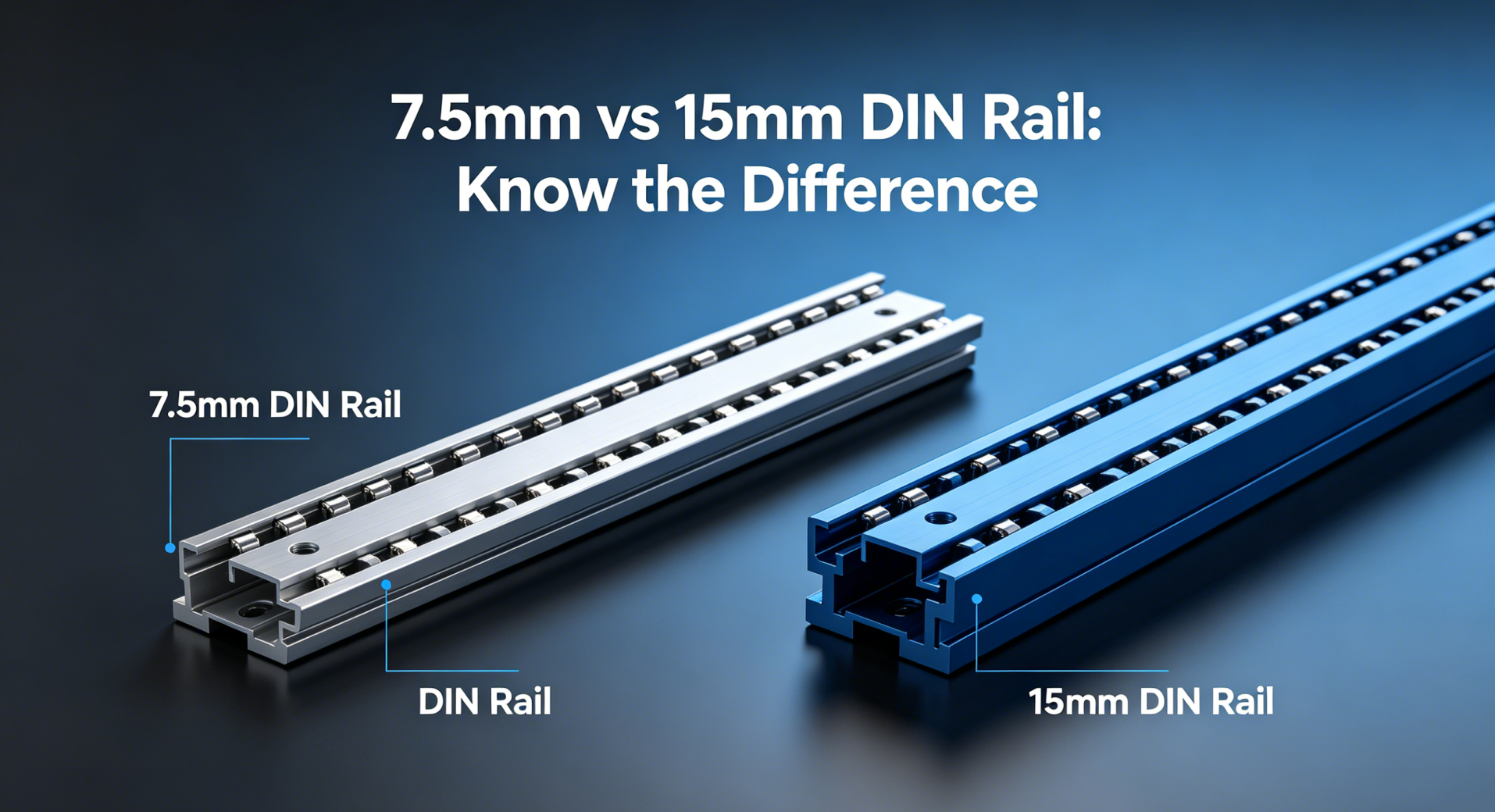
7.5 DIN Rail (TS35/7.5): Standard groove depth 7.5mm, low-profile lightweight type, the most widely used universal DIN rail in industrial automation.
15 DIN Rail (TS35/15): Standard groove depth 15mm, thickened reinforced type, with higher structural strength and load-bearing performance.
Both rails comply with IEC 60715 and EN 50022 international standards, supporting unified modular installation of mainstream electrical components, with excellent versatility and interchangeability.
15 DIN Rail has absolute advantages in load-bearing. Due to the 15mm deep groove reinforced structure, its overall rigidity is greatly improved, with no bending or deformation under heavy load. It is suitable for mounting heavy high-power switching power supplies, large contactors, and motor starters.
7.5 DIN Rail features a shallow groove and lightweight design. It meets the load requirements of conventional small modules but is prone to slight deformation when bearing heavy power supplies for a long time, affecting installation stability.
7.5 DIN Rail: Perfectly matches low-power & medium-power switching power supplies, signal relays, miniature circuit breakers, terminal blocks, and small PLC modules. It is the standard configuration for most compact control panels.
15 DIN Rail: Exclusive match for high-power industrial switching power supplies, heavy-duty electrical equipment, and tall modular components. The deeper clamping groove ensures tighter component locking, effectively avoiding loose contact caused by equipment vibration in industrial scenarios.
7.5 DIN Rail adopts a low-profile design, occupying smaller vertical space in the cabinet, maximizing internal wiring and heat dissipation space, and very suitable for slim and compact electrical enclosures.
15 DIN Rail has a higher profile, requiring reserved vertical installation space. It is more suitable for standard large and medium-sized industrial cabinets with sufficient internal space.
In industrial vibration, high-temperature, and long-term load working environments, 15 DIN Rail has stronger durability. The thickened structure resists aging and vibration, reducing later maintenance and replacement costs.
7.5 DIN Rail is more cost-effective and fully meets the service life requirements of commercial, civil, and light industrial scenarios.
You install low and medium power DIN-rail switching power supplies (5W-150W)
Compact control boxes, household electrical cabinets, and space-limited equipment
Mounting small relays, terminal blocks, sensors, and I/O modules
Commercial equipment, smart home systems, and light automation projects
You install high-power industrial switching power supplies (200W-1000W+)
Industrial production lines, automation equipment, and high-vibration workshop scenarios
Mounting heavy contactors, frequency converters, and large power modules
Projects requiring long-term stable operation and low maintenance rate
1. Blindly using 7.5 rail for high-power power supplies: Insufficient load-bearing causes rail deformation, power supply offset, poor heat dissipation, and equipment crash.
2. Wasting cost on 15 rail for low-power modules: Excessive structural performance leads to unnecessary procurement cost waste and space occupation.
3. Ignoring standard matching: Non-standard rails will cause switching power supplies and other core components to fail to snap in, delaying project delivery.
The core difference between 7.5 DIN rail and 15 DIN rail lies in groove depth, mechanical strength, load-bearing capacity, and scenario matching. 7.5mm DIN rail is cost-effective and compact, ideal for light-load and space-limited commercial & light industrial scenarios; 15mm DIN rail is reinforced and durable, the best choice for heavy-load high-power switching power supplies and industrial automation equipment.
As a professional B2B switching power supply account manager, we have rich experience in DIN rail power supply model matching and customized engineering solutions. We can provide one-stop supporting solutions for different DIN rail sizes and cabinet scenarios for global industrial buyers.

 English